16 November 2026
Local Growth Guide: Contractor Marketing for Montgomery, TX and The Woodlands, TX
Presented by @jasperehfa993
Contractors do not win work in Montgomery County by sounding big. They win by sounding local, credible, and easy to trust. That matters even more in Montgomery, TX and The Woodlands, TX, where homeowners often have options and commercial buyers tend to compare several bids before making a call.
I have seen excellent contractors lose jobs to weaker competitors for one simple reason: the better company never made the stronger case online. Their trucks looked sharp, their crews showed up on time, and their workmanship held up for years, yet their website was thin, their Google profile was neglected, and their photos did not reflect the quality they delivered in the field. Meanwhile, another company with average execution looked more established because it had fresh reviews, cleaner messaging, and a stronger local presence.
That gap is what good marketing closes.
If you are focused on contractor marketing Montgomery TX or trying to sharpen your approach to contractor marketing The Woodlands TX, the goal is not flashy branding for its own sake. The goal is to make it easier for nearby customers to find you, trust you, and contact you before they call the next company on the list.
The local market is not one market
Montgomery and The Woodlands sit close together, but they do not behave exactly the same way.
Montgomery has a mix of long-time residents, newer developments, rural properties, lake-area homes, and owners who often value practical experience over polished sales language. Projects can range from custom home work to repairs on older structures to upgrades tied to land use, outdoor living, and storm resilience. Referrals still carry serious weight there, but referrals alone rarely sustain growth if you want to scale beyond your current circle.
The Woodlands is different. Expectations tend to be higher around presentation, communication, and responsiveness. Homeowners often research more thoroughly before reaching out. They read reviews, compare galleries, check service pages, and notice whether your branding feels current or dated. Commercial opportunities can also be more process-driven, which means your credibility has to show up not only in person, but on every digital touchpoint.
A single generic message aimed at "homeowners in the Houston area" usually underperforms in both places. It is too broad to feel relevant. Contractors who grow steadily in these communities tend to localize their message in a way that feels natural. They mention actual service areas, show real projects from nearby neighborhoods, and speak to the kinds of concerns local customers already have in mind, whether that is drainage, humidity, heat, HOA expectations, premium finishes, or dependable scheduling.
The first job of marketing is to remove doubt
Most people do not hire a contractor because of clever copy. They hire because enough doubt has been removed.
When a homeowner lands on your website or Google Business Profile, they are usually asking a silent set of questions. Do you serve my area? Do you do the kind of work I need? Have you done it before? Are you reliable? Will you answer the phone? Are your prices likely to be fair for the level of work you provide? Can I picture you working on a house like mine?
Strong local marketing answers those questions quickly.
That means your website should not hide basic information. Your service area should be obvious. Your primary services should be described in plain language. Your photos should show real work, not generic stock imagery that looks borrowed from ten other sites. Your contact options should be visible without forcing someone to hunt through the menu.
For many contractors, that alone improves lead quality. People self-select more effectively when your marketing is clear. The right prospects contact you with better context, and the wrong prospects often filter themselves out before wasting your estimator’s time.
What actually moves the needle in Montgomery and The Woodlands
There is a lot of noise in marketing advice for contractors. Some of it is useful, some of it is expensive theater. In these two markets, a few fundamentals usually do most of the heavy lifting.
Your Google Business Profile is often more important than your homepage for first contact. A homeowner searching for a remodeler, roofer, painter, electrician, pool builder, or outdoor living contractor will usually see map results before they see your full website. If your profile has thin reviews, outdated hours, no recent photos, and no local detail, you are already at a disadvantage.
Your website still matters, but not as a digital brochure. It should act more like a trust-building sales tool. Service pages need enough detail to show expertise, but they also need to feel readable. Too many contractor sites are built like this: a home page with vague claims, a services page with one paragraph, and a contact page. That setup makes it hard to rank locally and hard to convert traffic into calls.
Reviews carry unusual weight in higher-trust service categories. In The Woodlands especially, I have watched homeowners compare contractors with almost forensic attention to review quality. They are not just counting stars. They are looking for patterns. Did people mention communication? Cleanliness? Follow-through? Handling of change orders? Respect for the property? Review language often does the selling your ad budget cannot.
Photography is another underused advantage. Good project photos outperform most marketing tactics because they compress proof into a glance. A clean before-and-after patio, a properly staged kitchen remodel, a finished custom pergola, a reroof with strong curb appeal, or a sharp commercial tenant improvement can do more than a paragraph of self-praise ever will. In affluent or design-conscious pockets of The Woodlands, photography is not optional. In Montgomery, where practical buyers may care less about polish, strong visuals still matter because they signal competence.
Why generic SEO fails local contractors
Search optimization for contractors often breaks down because companies chase broad traffic instead of relevant traffic. Ranking for "home remodeling" means very little if the visitors are outside your service area or looking for work you do not want.
Local intent matters more than vanity traffic.
If you want results from contractor marketing Montgomery TX, your site should have meaningful local relevance. That does not mean stuffing the phrase into every paragraph. It means building pages and content that make sense for someone in or near Montgomery. The same applies to contractor marketing The Woodlands TX. Search engines and human readers both respond better when the page reflects genuine local use cases.
That can include service pages tied to actual offerings, location pages written with care, project spotlights from nearby jobs, and FAQs based on real customer conversations. The mistake is creating thin location pages that simply swap city names and repeat the same lines. Those pages tend to feel hollow because they are hollow.
A better approach is to write each page as if you have actually worked there, because ideally, you have. Mention the types of homes, common project goals, logistical realities, and customer priorities that differ by area. If your crews know how scheduling shifts in gated neighborhoods, how drainage affects outdoor construction near sloped lots, or how premium-finish expectations shape remodeling work in master-planned communities, that is useful local knowledge. Use it.
Your website should sound like your best estimator
The best estimators do not overwhelm people. They ask smart questions, explain trade-offs clearly, and help the buyer feel oriented. Your website should do the same.
A strong contractor website in these markets usually has a practical structure. The homepage establishes who you are, where you work, and what you do best. Service pages go deeper on the work itself. Project galleries offer proof. About pages humanize the company without turning into autobiography. Contact pages remove friction.
The writing matters more than many contractors realize. Vague claims such as "quality craftsmanship" or "customer satisfaction" are so common they stop carrying weight. More convincing language sounds like lived experience. It explains how you handle substrate prep before painting, what separates a rushed bathroom remodel from one that lasts, why permit knowledge matters in certain projects, or how you coordinate trades to keep a schedule from drifting. Specifics create credibility.
This is especially important when your price is not the lowest. Better messaging helps explain why your bids come in where they do. If you use better materials, manage subcontractors more tightly, or invest more in site protection and communication, say so. Otherwise, the customer may compare your price to a cheaper bid without understanding the difference in scope or process.
Reviews need a system, not wishful thinking
Almost every contractor says reviews matter. Far fewer have a reliable process for getting them.
The companies that steadily build review volume usually make the ask at the right moment and keep it simple. They do not wait six months. They do not send vague requests. They do not ask every customer the same way regardless of project experience. They ask when the customer is visibly pleased, when the punch list is essentially done, and when the handoff feels complete.
A few habits work especially well:
- Ask in person first, then text or email the direct review link.
- Mention what kind of feedback helps, such as communication, timeliness, and the finished result.
- Train project managers and office staff to recognize the right moment.
- Follow up once if needed, but do not nag.
- Spread requests consistently instead of in random bursts.
That kind of discipline can change lead flow over a year. Ten high-quality local reviews written by real customers in Montgomery or The Woodlands often do more for trust than a broad awareness campaign. They also strengthen map visibility, which is where many buying journeys begin.
Paid ads can work, but only if the basics are solid
Some contractors try to solve a weak marketing foundation by buying leads or turning on ads too early. That can generate activity, but not necessarily profit.
Paid search can work well for emergency or high-intent services, roofing after storms, electrical troubleshooting, plumbing, HVAC, tree work, or urgent repairs. It can also support higher-ticket remodeling or exterior improvement categories if landing pages are strong. But if your reviews are thin, your website is generic, and your forms go unanswered for a day, ad spend tends to expose your operational weaknesses rather than fix them.
In Montgomery, paid ads may be effective when the message emphasizes practical expertise and fast local response. In The Woodlands, ad performance often improves when the landing experience looks polished and the proof points are stronger. Same service category, different buyer psychology.
There is also a simple economics issue. If a lead costs several dozen dollars or much more depending on competition, and your close rate is modest, every weak inquiry-handling habit becomes expensive. A missed call, slow callback, or vague follow-up email can quietly drain thousands from the budget over a season.
Content that brings in better leads
Most contractor content is either too broad or too self-focused. It talks about the company instead of the customer’s decisions.
Useful content meets buyers where they are. It answers the questions they ask before they are ready to sign. In Montgomery, that may mean discussing outdoor living durability, roofing material trade-offs, site drainage concerns, or the realities of renovating older homes. In The Woodlands, it may include kitchen remodel planning, premium bath finish choices, project timelines, or how to prepare for a renovation while living in the home.
One contractor I know started publishing short project breakdowns instead of generic blog posts. Nothing fancy. Just the scope, the client goal, a few site challenges, material decisions, and finished photos. Those pages were not written for awards. They were written for future customers trying to picture what their own project might involve. Within months, the company noticed a shift. Leads came in better informed, with clearer expectations and a stronger sense of fit. Close rates improved because the sales conversation started further down the field.
That is the real value of good content. It pre-sells by educating without lecturing.
The local brand signals that matter more than logos
Branding for contractors often gets reduced to visual identity. That matters, but local brand perception is built from repeated signals.
Do you answer the phone like a professional business or like someone caught off guard? Do your trucks look maintained? Are your yard signs readable? Does your estimator confirm appointments clearly? Are your proposal templates organized? Does your website match the caliber of homes you want to work on? Do your crews leave a clean jobsite at day’s end?
Those are all marketing signals.
In The Woodlands, brand consistency tends to carry more weight because customers often expect a smoother, more polished experience. In Montgomery, presentation still matters, but authenticity and reliability can matter even more than polish alone. A contractor who communicates plainly, shows up when promised, and has visible roots in the area can build a very strong reputation, even without glossy branding.
The key is alignment. If you want premium remodels, your marketing cannot feel bargain-bin. If you want practical repair and maintenance work at volume, your marketing should emphasize speed, clarity, and trust rather than luxury language. Too many contractors try to straddle every market segment and end up resonating with none.
Service-area pages, done the right way
Location pages have a bad reputation because so many are lazy copies. Still, when handled properly, they are valuable.
A service-area page for Montgomery should not read exactly like one for The Woodlands. The bones may be similar, but the substance should differ. Discuss the work you actually perform there, the types of properties you commonly serve, and the concerns that tend to come up in that area. If one market leans toward custom outdoor projects and another toward interior renovations with design-sensitive clients, reflect that.
The page should also link naturally to relevant services and project examples. If you have completed fencing, roofing, patio, remodeling, or commercial work nearby, connect the dots. Make it easy for the visitor to move from "yes, this company serves my area" to "yes, they have done the kind of work I need."
This is where many local SEO efforts either become persuasive or fall flat. The pages that win are not the ones that repeat the city name the most. They are the ones that feel most useful.
What contractors often overlook in lead handling
Marketing gets blamed for problems that really belong to sales operations.
I have seen contractors invest in strong websites and solid local visibility, only to sabotage results with poor follow-up. The office misses calls during lunch. Web forms trigger no alert. Estimate appointments get pushed without explanation. Proposals arrive late and thin on detail. Nobody follows up after sending the bid. Then the owner says the leads were no good.
Sometimes the leads were weak. Often, the process was weaker.
A homeowner in The Woodlands who reaches out to three contractors and hears back from one within fifteen minutes, one the next morning, and one two days later will naturally infer something about each business. Speed is not everything, but responsiveness is a quality signal. The same goes for Montgomery. Local customers may be more relationship-oriented, but they still notice when communication feels loose.
A simple lead-handling improvement can outperform a fancy campaign. Faster callbacks, better intake questions, tighter scheduling, clearer proposals, and a short follow-up sequence often raise close rates without increasing traffic at all.
Social media is useful, but not in the way many think
For most contractors, social media is not the core engine of lead generation. It is a support channel. That does not make it unimportant. It just means expectations should be realistic.
Social works best when it reinforces trust. Fresh jobsite photos, completed projects, brief walkthrough videos, team introductions, and customer highlights can local seo montgomery tx Results Digital help future buyers feel familiar with your work before they reach out. It also keeps your company looking active and current when someone checks your profile after finding you through search or referral.
The mistake is chasing entertainment trends while ignoring the basics. A contractor does not need to go viral. A contractor needs to look real, capable, and locally active. A simple phone video explaining why a deck frame was rebuilt correctly can outperform a polished but generic brand reel, especially with homeowners who value substance.
A practical way to prioritize your next 90 days
If your marketing feels scattered, narrow the focus. Most contractors do not need twenty tactics. They need a few that are executed consistently.
Here is a sensible 90-day sequence:
- Fix the foundation, update your Google Business Profile, sharpen service pages, improve contact flow, and add real project photos.
- Build review momentum with a repeatable ask process tied to project completion.
- Create local proof, publish a handful of strong project spotlights from Montgomery and The Woodlands.
- Tighten lead response, make sure calls, forms, scheduling, and proposals move quickly.
- Add paid campaigns only after the first four pieces are working well.
That order matters. It is much easier to spend money than to build trust, but trust usually has the better return.
The long game is reputation made visible
The strongest contractor marketing does not invent a reputation. It reveals one.
If your work is solid, your communication is improving, and your customers are generally happy, then your marketing job is to make that reality easier to see. Show the projects. Capture the reviews. Explain the process. Localize the message. Respond quickly. Keep your web presence current enough that it matches the business you are actually running.
For companies trying to grow through contractor marketing Montgomery TX, that often means leaning into local familiarity, practical credibility, and visible proof of dependable work. For companies focused on contractor marketing The Woodlands TX, it usually means pairing strong craftsmanship with a more refined presentation, better visuals, and a smoother buyer experience.
Both markets reward trust. They just read it a little differently.
If you get that right, marketing stops feeling like a separate department and starts acting like what it should be, a steady extension of the reputation you build on every jobsite.
About Results Digital
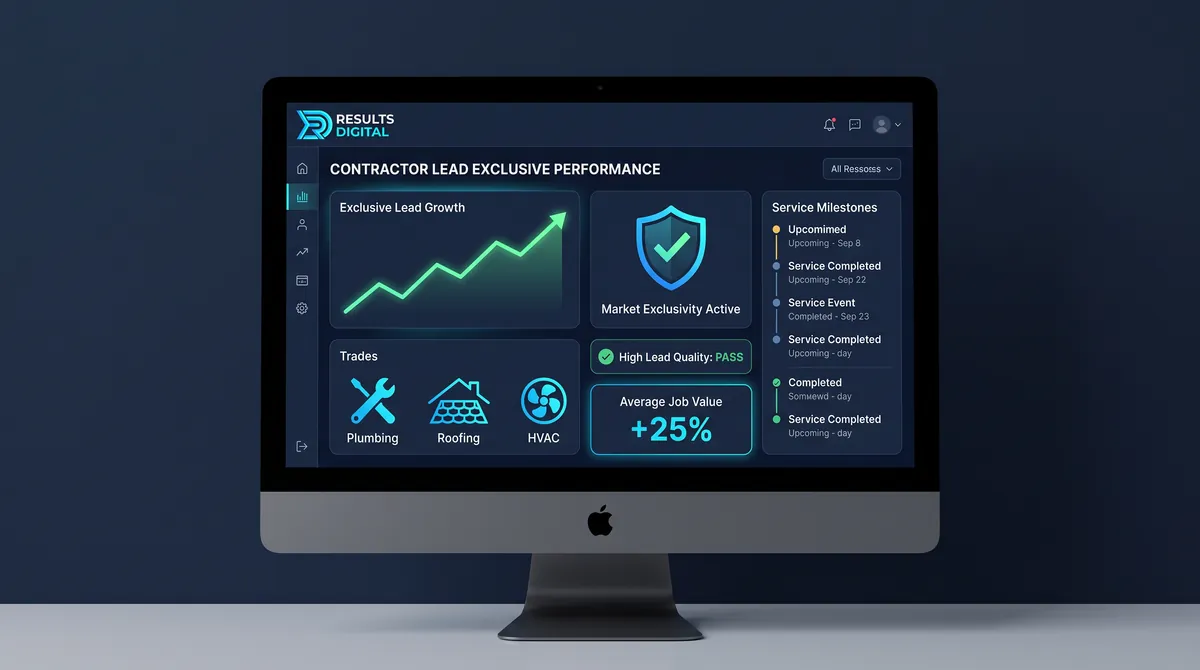
Results Digital is an internet marketing service in Montgomery, TX for contractors and trades: local SEO that ranks them in the Google map pack and AI search, and Google Ads (with Local Services Ads management) optimized to booked jobs. Month-to-month, one client per trade per market.
Montgomery, TX 77316 · Serving Montgomery County, The Woodlands, Conroe and greater Houston
Phone: (832) 850-2641
Website: resultsdigitalus.com
Find us on Google Maps